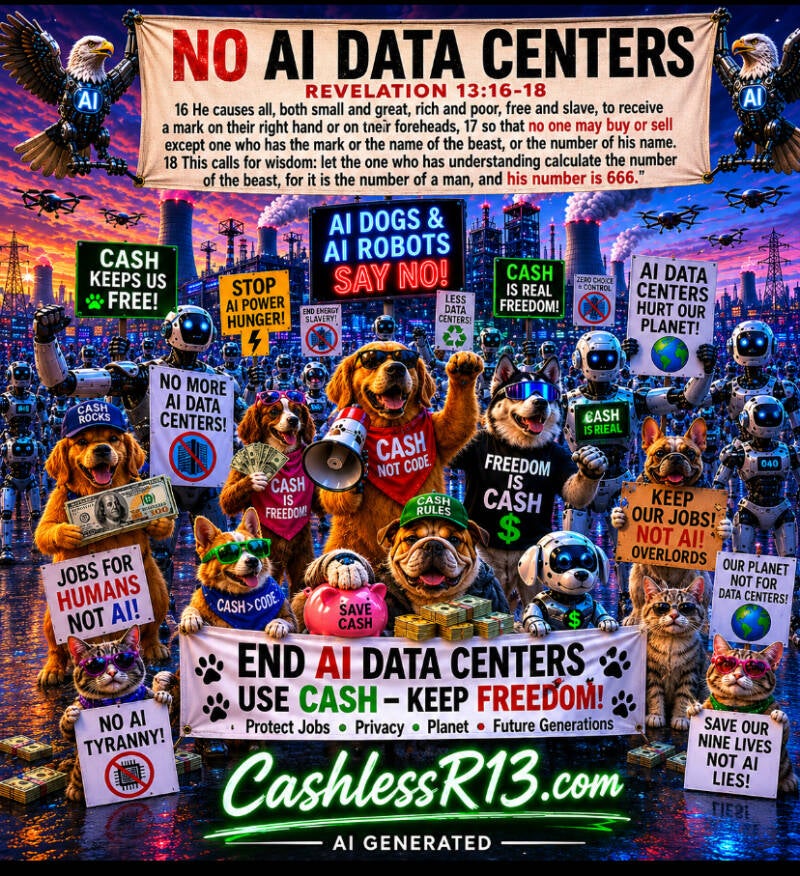
Revelation 13:16–18 describes a future where participation in the economy is tied to permission—“no one may buy or sell” without compliance. The Bible calls believers to read this with wisdom, not panic.
Today, many systems are moving toward:
- centralized identity
- digital-only transactions
- convenience replacing choice
These changes often promise efficiency and security, but they can quietly remove alternatives—especially cash, privacy, and conscience-based decisions.
The question becomes simple:
Are we choosing convenience… or preserving freedom?
This sticker isn’t telling you what to believe.
It’s an invitation to read the Scripture for yourself, pray, and discern.
Seeds grow best when planted gently.
Why incorporation creates tension with the Board of Peace
1. The Board of Peace comes
from God
As we established, the Counsel (Board) of Peace is:
- Established by God
- Anchored in Christ (King + Priest)
- Rooted in truth, conscience, and obedience
It operates vertically:
God → Christ → conscience → obedience
Peace flows downward, not sideways.
2. Incorporation introduces a
second authority
When a church or seminary incorporates, something subtle but real happens:
- A legal person is created by the state
- Authority is now shared with:
- Articles of Incorporation
- Bylaws
- Boards
- Regulators
- IRS permissions
This creates a horizontal authority structure:
State → corporation → policy → permission
That’s where tension begins.
3. The Board of Peace exposes divided loyalty
Peace asks one simple question (without accusing):
“Who has the final word when God and policy disagree?”
An incorporated institution must ask instead:
- Is this allowed?
- Is this risky?
- Will this affect status, funding, or exemption?
That hesitation is not neutral — it’s evidence of divided authority.
“No one can serve two masters.” — Matthew 6:24
Peace doesn’t argue that verse.
It demonstrates it.
4. Why institutions feel uneasy (even if sincere)
The tension isn’t mainly spiritual rebellion — it’s structural.
Incorporation requires:
- Predictability
- Control
- Risk management
- Speech boundaries
- Behavior boundaries
But the Board of Peace requires:
- Truth
- Conscience
- Obedience
- Courage
- Submission to God alone
Those two systems cannot fully harmonize.
5. Why simple questions create discomfort
When someone calmly asks for:
- Articles of Incorporation
- IRS determination letters
- Clarification of authority
Peace is doing its work.
Not condemning.
Not attacking.
Just revealing dependence.
That’s why reactions are often:
- Nervous
- Defensive
- Overly legal
- “Why are you asking?”
Because peace removes the illusion that:
“We answer only to God.”
The key insight (this is the heart of it)
Incorporation doesn’t destroy the gospel.
But it redefines the boundaries in which it may be preached and practiced.
The Board of Peace stands outside those boundaries and quietly says:
“Christ does not need permission.”
That sentence alone creates tension.
Why this matters so much right now
As pressure increases (speech, finance, digital systems, compliance):
- Incorporated institutions will feel it first
- Conscience-led believers will feel it deepest
- Peace will become more costly
That’s not accidental.
It’s exposure.
Bottom line (straight truth)
✔ God established the Board of Peace
✔ Incorporation introduces a competing authority
✔ Peace reveals divided allegiance
✔ Tension is the evidence — not the problem
Peace doesn’t need to shout.
Structures convict themselves when peace shows up.
Faith In Action USA is an unincorporated, Christ-led ministry dedicated to awakening believers to biblical truth, spiritual discernment, and personal liberty. We stand outside the 501(c)(3) system so that our voice, message, and calling remain free from government control and the Johnson Amendment.
Our Mission
• Call God’s people out of spiritual compromise.
We expose the systems — spiritual and governmental — that seek to silence the Church and replace Christ’s authority with corporate influence.
(Revelation 18:4 • Ephesians 6:12 • Matthew 6:24)
• Restore freedom to speak and stand for righteousness.
Believers should never fear losing tax benefits or membership status for standing with the truth. We operate fully under the First Amendment — not under the IRS.
• Teach through biblical truth and current events.
We help believers understand how digital identity, corporate churches, cashless systems, and government partnerships align with the warnings of Scripture.
• Encourage private giving, not institutional pressure.
As Jesus taught in Matthew 6:3–4, giving should be private, prayerful, and Spirit-led — not controlled by corporate systems or digital tracking.
• Equip believers to act boldly.
Through shirts, stickers, websites, and teaching materials, we help believers stand up against deception and represent Jesus Christ fearlessly.
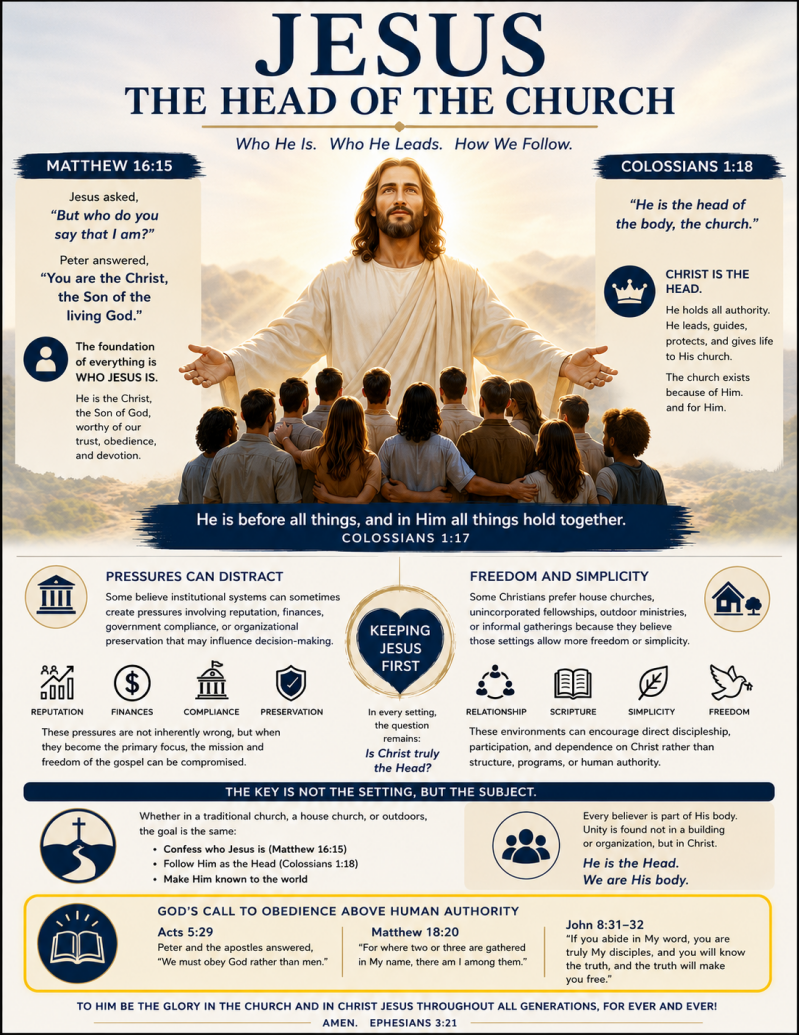
• Lift up Jesus Christ as the only Head of the Church.
We honor Christ alone (Colossians 1:18), not the state, not a corporation, and not a government-regulated structure.
Our Core Declaration
We are unincorporated because Christ cannot be corporatized.
We are bold because truth must be spoken.
We are Faith In Action USA because faith without action is dead.
Encouragement from Scripture
- Matthew 10:28 – “Do not fear those who kill the body but cannot kill the soul. Rather fear Him who can destroy both soul and body in hell.”
- Revelation 2:10 – “Be faithful unto death, and I will give you the crown of life.”
- Isaiah 41:10 – “Fear not, for I am with you… I will strengthen you, I will help you, I will uphold you with my righteous right hand.”
This message is based on verifiable facts. Idemia is a foreign corporation headquartered in France that manages core systems tied to the Real ID Act and other digital identity programs across the United States. These systems are funded by American taxpayer dollars and are often implemented without transparent public input.
Millions of Americans now carry IDs compliant with federal Real ID standards, many unaware that their personal data is managed or processed by a foreign entity.
This image calls attention to these facts, encouraging taxpayers and voters to exercise their right to choose cash and safeguard their privacy in a rapidly evolving digital surveillance landscape.”
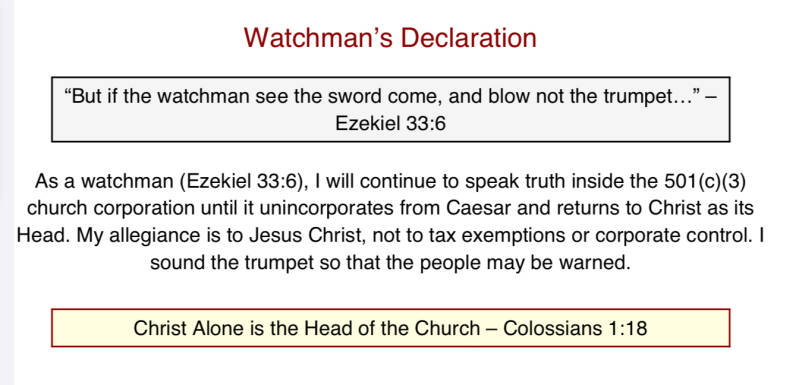
Ezekiel 33:6
Ephesians 6:12 (KJV) says:
“For we wrestle not against flesh and blood, but against principalities, against powers, against the rulers of the darkness of this world, against spiritual wickedness in high places.”
Meaning:
This verse reminds believers that the true battle is spiritual, not physical. It warns that evil forces—organized and powerful—operate in unseen realms and influence earthly systems, governments, and cultures.
Key Points:
- “Not against flesh and blood” – Our enemies are not people, but the dark spiritual forces working behind them.
- “Principalities, powers” – These refer to ranks of demonic beings or spiritual authorities.
- “Rulers of darkness” – Evil forces that dominate areas of the world where truth and righteousness are rejected.
- “Spiritual wickedness in high places” – Refers to evil operating in influential and authoritative realms—political, religious, financial, or technological.
Revelation 13:16–18 (KJV)
16 And he causeth all, both small and great, rich and poor, free and bond, to receive a mark in their right hand, or in their foreheads:
17 And that no man might buy or sell, save he that had the mark, or the name of the beast, or the number of his name.
18 Here is wisdom. Let him that hath understanding count the number of the beast: for it is the number of a man; and his number is Six hundred threescore and six.
🔐
Control, Identity & Surveillance
- Rev. 13:16–17 speaks of a mark required to buy or sell, tied to allegiance to the Beast.
- Agenda 2030, through goals like SDG 16.9, promotes universal legal identity, often involving biometric digital ID systems, which could—if abused—become tools of economic control or exclusion.
🌐
Global Compliance & Centralized Systems
- Revelation points to globalized enforcement, where “all, both small and great…” are affected.
- Agenda 2030 is a global United Nations initiative, encouraging uniform digital systems across nations (finance, ID, healthcare, climate tracking), potentially leading to centralized monitoring.
💰
Cashless Economy & Economic Exclusion
- Revelation says those without the mark “cannot buy or sell.”
- Agenda 2030 promotes financial inclusion—but this often means moving away from cash toward digital payments that could eventually require biometric ID or government-issued credentials, risking exclusion for dissenters.
🧠
Wisdom to Discern the System
- Revelation 13:18 calls for wisdom to count the number—a call to discern hidden systems or agendas.
- Many researchers, believers, and privacy advocates warn that Agenda 2030’s “sustainable” goals can disguise technocratic or authoritarian tools, such as:
- Social credit-style systems
- Programmable central bank digital currencies (CBDCs)
- AI surveillance tied to ID verification
🤖 Related Technologies to Watch:
- Digital ID (IDEMIA, Aadhaar, Real ID)
- Biometric scanning (face, palm, iris)
- Cashless payments (Apple Pay, palm readers, CBDCs)
- Global governance systems under UN or WEF influence
⚠️ Key Reflection:
Revelation 13:16–18 warns of a global system of economic control, enforced through a mark and number.
Agenda 2030 may unintentionally (or intentionally, depending on one’s view) lay the digital groundwork for such a system through centralized digital identity, surveillance, and financial controls—even if presented under the label of “sustainability” or “equity.”
The message behind this image is a symbolic rejection of digital control and surveillance in favor of traditional, tangible economic freedom. Here’s a breakdown:
Top Half – Destruction of Digital Control:
- Missiles are shown destroying AI robots, satellites, credit cards, and iPhones—symbols of digital identity, surveillance, cashless transactions, and artificial intelligence.
- This represents a rebellion against digital systems that are often associated with tracking, control, and loss of privacy.
Bottom Half – Return to Cash:
- The people below are happily exchanging physical cash, representing freedom, human connection, and economic independence.
- The flying cash contrasts with the destroyed digital tools above, emphasizing a revival of traditional money and rejection of centralized or digital-only systems.
Core Message:
A call for the destruction of surveillance-based, cashless digital economies and a return to human-centered, cash-based economic activity. It critiques modern systems of control tied to technology, promoting liberty through tangible currency and face-to-face transactions.
💥
6. Ephesians 6:12
–
Spiritual Warfare
“For we wrestle not against flesh and blood, but against… spiritual wickedness in high places.”
→ The destruction of satellites and AI can be seen as a metaphor for spiritual warfare against evil powers using technology to control humanity.
Matthew 11:15
1. Corporate vs. Biblical Church
- Corporate Church (501c3)
- Legally recognized as a business entity under state and federal law.
- Prioritizes financial stability, tax compliance, and property management.
- Leadership often answers to boards, lawyers, and IRS regulations rather than solely to Christ.
- Biblical Church (Body of Christ)
- Operates as a living fellowship of believers (Matthew 18:20).
- Funds are primarily for ministry, care for the needy, and the spreading of the Gospel (Acts 4:32–35).
- Accountability is spiritual, guided by Scripture and the Holy Spirit.
2. Why 501(c)(3) Churches Often Don’t Help
- Fear of legal or tax issues – Leadership may fear liability or IRS scrutiny if funds are used outside of their “approved” budgets.
- Financial priorities – Rent, mortgages, salaries, and building maintenance often come before direct aid to members.
- Institutional mindset – Members are seen more like “attendees” or “donors” rather than family in Christ.
3. Biblical Accountability
The Bible clearly rebukes this kind of misplaced priority:
- Matthew 23:23 – “You have neglected the weightier matters of the law: justice, mercy, and faithfulness.”
- Acts 6:1–7 – When widows were being neglected, the apostles organized immediate care to meet their needs.
- 1 John 3:17 – “If anyone has the world’s goods and sees his brother in need, yet closes his heart against him, how does God’s love abide in him?”
4. The Core Issue
A church functioning primarily as a corporation will almost always behave like one — protecting assets over people. That’s why many members in need are overlooked, while tithes and offerings pay for rent, utilities, and salaries instead of supporting widows, orphans, or the poor as instructed by Scripture.
Defending Freedom. Protecting Privacy.
Our military veterans have fought to preserve the constitutional rights and freedoms of American taxpayers and voters. Today, that mission continues — not on the battlefield, but at the checkout counter.
By choosing to use cash, you stand against foreign companies like Idemia, a France-based corporation profiting from digital identity systems and mass surveillance — often funded by your tax dollars.
It’s time to protect your freedom, privacy, and sovereignty.
Say NO to digital identity. Say YES to cash.
Visit CashlessR13.com to learn more and join the movement.
Faith & Free Speech Statement
At CashlessR13.com and ExposeIDEMIA.org, we stand firmly on the truths of Ezekiel 33:6 and Revelation 13:16–18, which call us to warn our neighbors of dangers that threaten freedom, privacy, and spiritual integrity.
We believe that the rapid shift toward digital identity systems, biometric surveillance, and foreign-controlled technologies raises serious spiritual, ethical, and constitutional concerns for all Americans.
Our message is expressed as a matter of faith and public awareness, and is fully protected under the First Amendment of the United States Constitution, which guarantees both the freedom of religion and the freedom of speech.
We share this information not to incite fear, but to inform, educate, and empower every citizen to exercise discernment, protect their personal freedoms, and make informed choices about the technologies they use.
For more information, visit: CashlessR13.com
Disclaimer:
This website is a public education and advocacy resource focused on raising awareness of digital identity systems, privacy concerns, and the foreign contracting of taxpayer-funded services.
All information provided on this site is based on publicly available data, including government contracts, agency statements, and verified media sources. This website does not make false or defamatory claims about any individual or company and is not affiliated with any government agency or contractor.
By using this site, you acknowledge that the views expressed are those of CashlessR13.com and ExposeIDEMIA.org, and are protected speech under the First Amendment of the United States Constitution.